


The Budapest–Belgrade high-speed railway project is a key component of the transportation corridor linking Central and Southeastern Europe. Initiated in 2014 under China’s “Belt and Road” initiative, the project has become a strategic element for boosting freight and passenger transport between the European Union and the Balkans.
SRBIJA NEWS — The new railway, approximately 350 kilometers long, connects the capitals of Hungary and Serbia. Of the total length, 183 km lies within Serbian territory and 152 km in Hungary. Upon completion of all modernization stages, travel time will be reduced from 8 hours to just 2 hours and 40 minutes — a transformation set to revolutionize logistics and tourism in the region.
Serbian Section of the Project
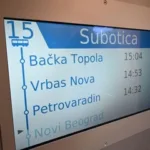
In March 2022, Serbia launched the first high-speed segment between Belgrade and Novi Sad (80 km), where the modern “Soko” train now operates. This train completes the route in under 40 minutes, offering a new level of comfort for domestic transportation. In April 2024, the Novi Sad–Subotica section was fully modernized, and on July 5, 2024, the newly renovated Novi Sad station — a critical hub near the Hungarian border — was officially opened.
Hungarian Section and Chinese Involvement
Construction works on the Hungarian side began in October 2021. The project is being carried out in collaboration with Chinese firms China Railway International and CCCC, supported by Hungary’s state-owned railway company MÁV. The financing is covered by a loan from China’s Export-Import Bank, which provides around €1.6 billion, or 85% of the total cost.
A fleet of 20 modern high-speed trains, manufactured by Chinese company CRRC, will operate along the route. These trains are compliant with European TSI standards, capable of reaching speeds up to 200 km/h, and are scheduled to enter service by late 2025.
Politics, Controversies, and Investigations
The project has been strongly supported by the political leadership of both Serbia and Hungary. Hungarian Prime Minister Viktor Orbán and Serbian President Aleksandar Vučić have repeatedly emphasized its geopolitical and economic importance. However, the European Commission has criticized the procurement process, launching an investigation over the lack of transparency and the use of direct contracts with Chinese contractors.
Further controversy arose in 2023, when the roof of the newly rebuilt Novi Sad station collapsed, tragically killing 16 people. The incident sparked widespread public outcry and raised concerns about the quality of Chinese engineeringin strategic infrastructure projects across Europe. Social media and press coverage focused on the potential risks of over-reliance on foreign construction standards.
Project Status as of Summer 2025
As of mid-2025, the Serbian portion of the railway is fully completed and operational. The Novi Sad–Subotica section is in service, while modernization work on the Hungarian segment is nearing completion. Full-scale high-speed operations between Budapest and Belgrade are expected to launch by the end of 2025.
Discussions on border control procedures are ongoing. Officials are considering implementing a “green corridor” that would allow trains to pass through the border without long stops, significantly improving efficiency for passengers.
Future Prospects: The Pan-European Railway Corridor
The Budapest–Belgrade high-speed railway is just one segment of a larger trans-European transportation route that will eventually extend through Belgrade, Niš, Skopje, Thessaloniki, and terminate in Athens. This broader corridor is expected to strengthen trade, tourism, and integration between Southeastern Europe and the EU.
Construction on the Belgrade–Niš section is already underway, with completion expected between 2026 and 2027.
Sources & corrections
SRBIJA NEWS identifies sources and updates information when available. If you notice an error or can provide verified local information, please contact the newsroom.
Send a correction or updateRelated stories
 When Will the Belgrade-Budapest High-Speed Train Launch? What We Know So Far
 High-Speed Train Spotted at Subotica Station: When Will Services to Belgrade and Budapest Begin?
 President of Serbia Aleksandar Vučić Announces Completion of the Novi Sad – Subotica High-Speed Railway Connecting Serbia with Europe
Serbia and Italy to Restore the Belgrade-Trieste Railway: Major International Infrastructure Project Announced