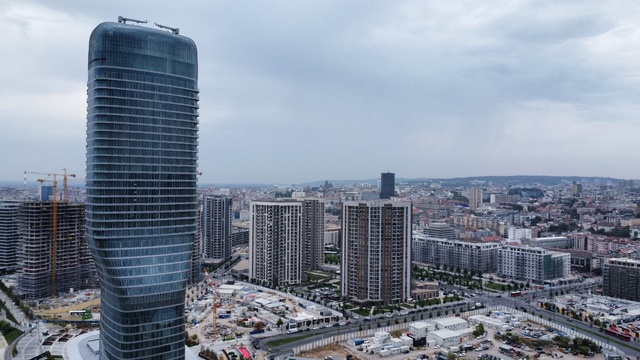
At the beginning of 2026, Serbia’s real estate market has definitively ceased to be a purely domestic phenomenon. It has become a point of intersection for different biographies, languages, and life strategies. Buying a house or an apartment here is increasingly not a speculative investment and not an act of escape, but a conscious choice of a new foundation.
SRBIJA NEWS – For a long time remaining on the periphery of major European markets, Serbia has unexpectedly turned into a country where several factors have converged at once: comparatively affordable property prices, a clear and accessible legalization mechanism, the right to work, and a calm social environment.
According to data from the Republican Geodetic Authority of Serbia (RGZ), cited by Serbian business and news outlets, the share of foreign buyers in the real estate market has grown significantly in recent years. In 2022, foreign citizens accounted for 2.93 percent of all property purchase transactions, while in 2023 this figure rose to 4.81 percent. In absolute terms, this means that around ten thousand properties were acquired by foreigners over just two years.
In 2024, RGZ reported a total of 126,787 real estate sale contracts, but as of January 2026, no official breakdown has been published showing the exact share of transactions involving foreign buyers for 2024, nor are there final annual figures for 2025. Nevertheless, market participants and Serbian media consistently point to sustained interest from citizens of Russia, European Union countries, and China.
To understand what lies behind these percentages, it is enough to listen to those who work with buyers on a daily basis. Denis Chizhov, a real estate consultant at EDS Project, moved to Serbia himself several years ago and now accompanies transactions for foreign clients across the country, from Belgrade to small settlements in Vojvodina. According to his observations, “absolutely everyone” is coming to Serbia today: Hungarians, Germans, people from post-Soviet countries, IT specialists, families with children, and those simply seeking a quieter pace of life.
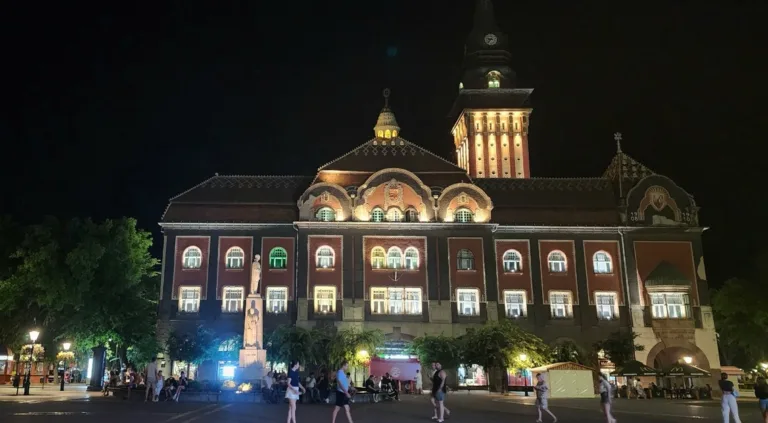
The main question clients ask repeatedly is why people come here and what they do after buying a home. Chizhov emphasizes that there is no single answer, because everyone has different goals. Some continue working remotely and choose villages with reliable high-speed internet. Others take jobs at local factories or enterprises. Many open sole proprietorships or start small businesses and service companies. Some live in rural areas but commute to larger cities such as Novi Sad, Subotica, or Belgrade. At the core of most decisions is practical logic: access to infrastructure and the ability to live more calmly without losing professional or social connections.
Legalization is a separate and crucial topic. Serbia remains one of the few European countries where a temporary residence permit can be obtained relatively easily on the basis of property ownership. After completing a purchase with a notary, an applicant submits a set of documents—electronically in some regions, in person in others. In most cases, the procedure is straightforward: the application is reviewed, the applicant is invited for photographs and fingerprinting, and then a residence permit card is issued.
A key detail is that there is no minimum property price requirement. As Chizhov explains, a house may cost five, ten, or fifteen thousand euros—the decisive factor is not the price, but whether the property is suitable for living. The presence of water and electricity, the absence of an emergency condition, and actual residence at the address are what matter. If the property is in poor condition, it must first be renovated and connected to utilities before applying. Otherwise, the residence permit application may be denied.
At the same time, Chizhov warns that there are no one-hundred-percent guarantees. The final decision is always made by police officers at the foreigners’ department. This is why he is skeptical of so-called “helpers” who promise guaranteed residence permits. In real life, he says, reputation matters far more than loud assurances. A trusted lawyer, a reliable notary, and a long-term real estate agent are far more valuable than random intermediaries offering shortcuts online.
A residence permit based on property ownership grants not only the right to live in Serbia, but also the right to work. This fundamentally changes the logic of relocation. For many, buying property is not the end goal, but a starting point. One can work as an employee or be self-employed, depending on skills and ambitions. Skilled manual labor is particularly in demand: electricians, plumbers, tilers, plasterers, and renovation specialists. According to people in the sector, good professionals are in short supply, and those who organize their work properly often find themselves booked months in advance through recommendations rather than advertising.
The language barrier in practice is far less dramatic than it may appear from abroad. In multilingual regions of Vojvodina, especially areas with a strong Hungarian presence, many residents speak several languages—Serbian, Hungarian, and English. Chizhov believes that difficulties arise mainly for those who isolate themselves at home and avoid communication. Those who switch their phone interfaces to Serbian, watch local news, read, and talk to neighbors usually absorb the language more quickly and naturally. In a new country, it is impossible to avoid interaction altogether: one has to deal with banks, documents, utility services, and schools. It is precisely in these everyday situations that the language gradually settles into memory.
This process of adaptation is well illustrated by the experience of Nikolai Suvorov, a Russian citizen who moved to Serbia with his wife and two children just over a year ago. In 2023, the family sold their house in Russia and came “to explore,” without turning the trip into a rigid long-term plan. They started in Belgrade, rented a car, and traveled around the country, visiting the south and mountainous regions. Quite quickly, they realized that life in the mountains, while appealing in theory, also means daily logistical challenges. In the end, they chose Vojvodina, guided by the condition of houses, practical considerations, quality of life, and the possibility of legalizing their stay without excessive bureaucracy.
The residence permit process for Suvorov went quickly. They arrived in summer, and by September all documents were finalized. Much of the application was submitted electronically, even though they were living in a village rather than a major city. Initially, Nikolai continued working remotely, but over time he deliberately began searching for local employment. In his view, English alone is not enough for deeper integration, so he started learning Serbian on the ground. Eventually, he found work as an insurance agent, focusing mainly on Russian-speaking clients, since fully working with locals in his area would also require a strong command of Hungarian.
The most challenging aspect for the family turned out to be schooling. The children had spent nearly a year studying remotely in a Russian online school, which Nikolai describes as a “disaster.” Only after arriving did they learn that the local school in their village taught all subjects in Hungarian. At first, this came as a cultural shock, but the family decided to keep the children there so they could build friendships in their own community and avoid daily commutes to another town.
After more than a year, both children now speak Hungarian and English at school, Russian at home, and keep Serbian in mind as a language they may learn gradually. When the parents suggested transferring them to another school, the children refused.
Suvorov also highlights a point often overlooked amid stereotypes: everyday attitudes toward newcomers are generally welcoming. Their first rental experience in Serbia was marked by a visit from the owners’ parents, who arrived with wine, coffee, and sweets for the children—a gesture the family says they had not encountered elsewhere. As for frequent discussions about high prices, Nikolai approaches them pragmatically. Everyone’s grocery basket is different, and price comparisons without context are misleading. He considers the quality of food, especially meat, to be noticeably higher. Fuel prices and toll roads are seen as part of European reality, balanced by the freedom to travel and explore the country.
All these details together form a clear portrait of the foreign property buyer in Serbia at the start of 2026. People are not purchasing houses and apartments in order to hide behind fences. They work, build routines, organize logistics, enroll their children in schools, learn languages, open services, and gradually become part of local life.
For some, Serbia is a transitional stage; for others, a long-term choice. But the market itself has already changed. Increasingly, Serbia is no longer viewed as merely a “cheap alternative,” but as a place where buying property becomes the first step toward a stable and sustainable new life.